Hospital-Grade Disinfectants at the Office
Mass Janitorial
Concord, MA · in business since 2010
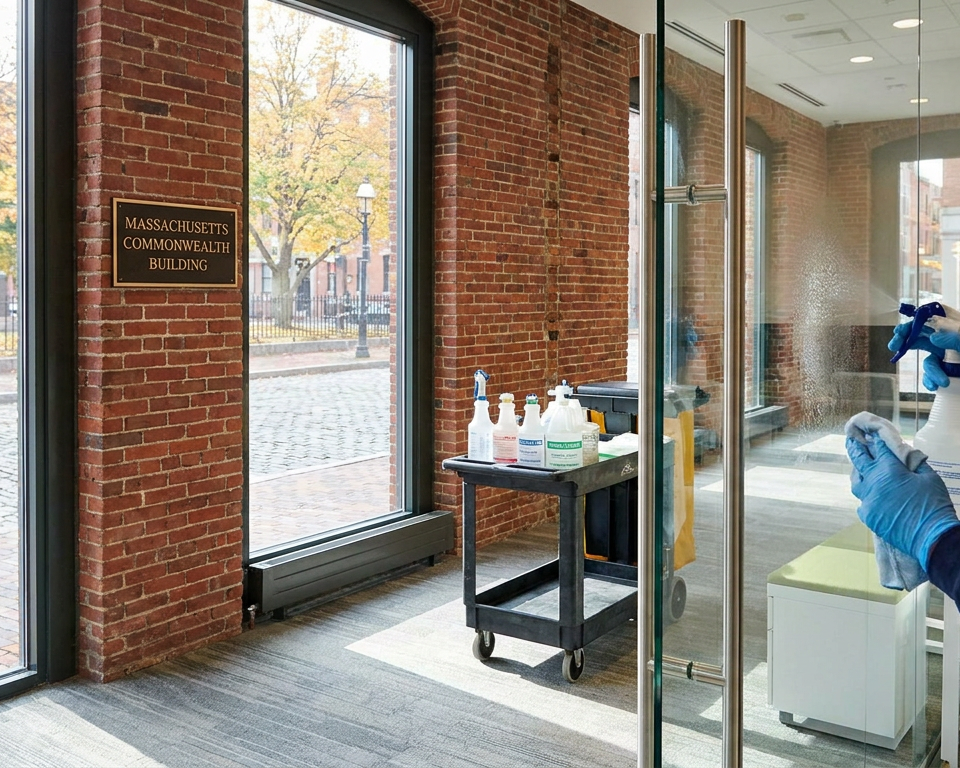
You can usually tell how a weekend went in an office by the break room on Monday morning. Someone left coffee in the pot, there’s a fingerprint haze on the fridge handle, and the front door pull has already been touched by half the staff before 9 o’clock. In a medical office, everyone expects those contact points to matter. In a regular office in Concord, Acton, Bedford, or Lexington, people notice them too, even if they don’t say it out loud. They just know when a space feels clean, and they definitely know when it doesn’t.
That’s where the phrase “hospital-grade disinfectant” tends to show up, and it can sound a little bigger than it really is. A lot of people hear it and picture something harsh, overly chemical, or meant only for exam rooms and surgical settings. The plain truth is simpler than that. “Hospital-grade” usually means the product is EPA-registered and approved to kill specific bacteria and viruses when it’s used according to the label. In other words, it’s not magic, and it’s not about spraying stronger chemicals everywhere. It’s about using the right product, on the right surface, in the right way, for the right amount of time.
That last part is what most people miss, and honestly it’s where the science lives. A disinfectant is only effective if it stays wet on the surface long enough to do its job, which is why you’ll hear cleaning crews talk about dwell time or contact time. If a label says a surface needs to stay visibly wet for a few minutes, wiping it dry right away undercuts the whole process. The same goes for dirty surfaces. If there’s grease, dust, food residue, or plain old office grime sitting between the disinfectant and the surface, the product cannot work the way it was tested to work.
That’s why in real-world office cleaning, we don’t treat cleaning and disinfecting as the same thing. Cleaning removes the soils you can see and plenty you can’t. Disinfecting is the next step, and it matters most on high-touch points like door hardware, light switches, shared desks, faucet handles, break room counters, and restroom fixtures. When our crew is working an overnight shift between 5 PM and 10 PM, that sequence matters because we’re not just trying to make a place look neat for the morning. We’re trying to leave behind a healthier, more reliably maintained environment by the job, not by racing the clock.
Once you look at it that way, the question stops being whether a product sounds strong and starts becoming whether the whole process makes sense for the building. In a small office with 10 to 30 employees, you usually don’t need the same level of disinfection everywhere, every night. You do need consistency in the places people share. Restrooms, kitchen areas, reception counters, conference room tables, and entry points take the most wear, and they’re also where cross-contact happens fastest. A measured approach is not cutting corners. It’s what keeps the work effective and cost-effective at the same time.
What the science actually means in a normal office
The science behind these products is less mysterious than the marketing makes it sound. Different disinfectants work in different ways, but the basic idea is that they break down or disrupt the microbes they’re labeled to target. Some damage cell walls, some interfere with proteins, and some inactivate viruses by disrupting their outer structure. None of that helps if the product is mismatched to the surface or used carelessly. That’s why a good cleaning plan pays attention to materials in the building, because a painted door, a stone counter, a vinyl floor, and an electronic touch screen all need a little more thought than one generic spray bottle can give them.
It also helps to remember that office environments are about traffic patterns as much as chemistry. The shared copy room may matter more than a private office that one person uses all day. A retail counter in Lincoln or Weston may need repeated attention because customers are constantly leaning on it, tapping cards, and signing receipts. A medical practice in the Bedford, MA area has another layer of concern, which is why we use HIPAA-aligned protocols in those spaces and pay close attention to touch points, exam room turnover needs, and privacy while we work. The product matters, but the map of human behavior in the building matters just as much.
That’s also the point where we talk honestly about what disinfectants can and cannot do. They reduce risk. They do not create a sterile environment in a typical office, and anybody promising that is overselling it. People come in from the parking lot, the train, the grocery store, school drop-off, and job sites. The best you can do is lower the microbial load on the surfaces that get touched over and over, do it consistently, and pair that with sensible cleaning routines so the space keeps up with the way people actually use it.
Because of that, we put a lot of emphasis on product selection and application, not just effort. When a disinfectant is on the EPA’s List N, for example, that tells you it’s been reviewed for use against certain emerging viral pathogens when used according to label directions. That still leaves room for a lot of good or bad execution. Using too much product can leave residue, create odor problems, or wear down finishes over time. Using too little, or using it on a dirty surface, can leave you with the appearance of disinfection without much of the benefit. Good work in this area is careful work.
Why office owners should care about the method, not the buzzword
For most business owners around Concord and the surrounding Middlesex County towns, what really matters is trust. You want your employees to walk in on Tuesday morning and feel like someone paid attention. You want clients not to notice sticky counters, smudged glass, or a restroom that looks fine from the doorway but falls apart up close. And if you manage a medical or professional office, you want the cleaning crew to understand where ordinary janitorial work ends and more sensitive protocols begin. That confidence does not come from a label alone. It comes from a crew that knows what to clean first, what to disinfect next, and what to leave alone.
That’s one reason we’ve always preferred practical, month-to-month service over locking people into something rigid. Buildings change. Staff size changes. Flu season changes the pressure points in a workplace, and post-construction cleanup or one-time event cleaning brings in a different kind of mess entirely. A good cleaning partner should be able to adjust the plan while keeping the standard steady, whether that’s an office, a retail space, a house of worship, or a medical suite. In our experience, the businesses that stay cleanest are not the ones using the most dramatic products. They’re the ones following a sound routine without skipping steps.
So when someone asks whether hospital-grade disinfectants belong in an office, our answer is yes, often they do, but the product is only one part of the story. The real value is in knowing where disinfection matters, how to apply it properly, and how to fit it into a cleaning plan that respects your staff, your surfaces, and your schedule. That’s the part people don’t always see when they walk into a clean office on Monday morning. They just notice that the break room doesn’t smell like old coffee, the door pulls aren’t tacky, and the place feels ready for the week. If you want a second set of eyes on what that could look like in your space, we’re always happy to do a free walkthrough and talk it through in plain English.
Sources & References
More in this category
- Office Floor Care: VCT, Wood, or Stone?
VCT, hardwood, and stone floors do not respond to the same cleaning routine. This guide walks Concord-area business owners through what each surface needs, what commonly goes wrong, and how a practical maintenance plan helps floors last longer and look better.
- Indoor Air Quality and Employee Wellness
Indoor air quality problems often show up as stale rooms, dust, and lingering odors long before anyone names them. This post explains, in plain terms, how recurring professional cleaning supports employee wellness in Concord-area offices and shared workspaces.
- Green Cleaning for Offices in 2026
Green cleaning in 2026 is less about marketing claims and more about using the right EPA-registered products in the right places. Here’s how Concord-area offices can balance lower-odor daily cleaning with proper disinfection that holds up in the real world.
Want this handled at your facility?
Start with a free walkthrough. Same business day reply. No obligation.